I felt in need of a great pilgrimage, so I sat still for three days. ~ Hafiz
Movement is essential to life. So is stillness. Movement and stillness, yang and yin, create the dynamism and rhythm of life. Like the positive and negative poles of a battery creating dynamic energy. The activity of daytime is balanced by rest in the dark of night. Gathering and expending energy. Stillness is the warp of life, creating stability; movement the weft, the textures and colors weaving right to left, left to right. Together creating the fabric of our life. Movement and stillness is the ongoing dance of life.
Movement Arises From Stillness
In the Asian practices of Tai Chi, Qi Gong, and martial arts, movement arises from stillness. In Tai Chi the term wuji describes the moment of stillness before movement. This is the stillpoint, a place of dynamic equilibrium, harmony, and emptiness. Here we are centered and grounded. And movement naturally arises from this place.
On the physical level, movement arises from the Dan Tien, the physical center of the body located in the belly area, as we are rooted and connected to the earth through the soles of our feet. Our mind and heart are clear and still; allowing internal and external awareness. This increases our sensory and intuitive awareness and knowing; allowing us respond appropriately in the moment.
When our mind is busy with many thoughts we can’t move with clarity or intention. When we are activated by anger, fear, hatred, past memories, or other strong emotions we may react instead of respond and do something we might later regret.
Many years ago, I learned from friends that much of their martial arts training was about how to avoid getting into a fight; how to deflect aggression and avoid head-on conflict. Our first task, in other words, is to master ourselves. One key is to remain calm and centered. This conserves our energy and focus and gives more of a chance to asses the situation and hopefully to diffuse an aggressor without physical force.
When we’re calm and centered in our inner stillness, we’re not in a rush, we have nothing to prove, we’re simply paying attention and are aware of both ourself, our environment, other people, and the undercurrents of what’s going on. Thus the trained martial artist can sense the intention and next moves of the other person and can decide how to respond; whether to step aside and deflect, or take action.
This morning our Tai Chi instructor reminded us again of the importance of staying in our center; aligned feet to head; earth to heaven. The Dan Tien, lower belly, always centered not twisted right or left. Body relaxed. Shoulders down, knees relaxed, feet rooted. Allowing our energy to sink down.
These are also some of the basics in the Qi Gong practice which I used to teach. This rooted relaxed stance fosters a stillness in our center that allows us to move with ease and power. When we are wobbly, not aligned, moving off kilter, there is no grounding center and our movements can cause discomfort and injury. Find your center axis, with a grounded relaxed stance, and feel the stability and stillness. Allow movement to arise from this place with awareness.
Meditation Cultivates Stillness and Awareness
Similarly, in meditative practices, one simply sits, taking an aligned and relaxed posture that allows the body, mind, and emotions to quiet. Movement practices like Tai Chi, Qi Gong, and Yoga help build the strength and flexibility that allows you to sit for long periods of time. And these movements balance the stillness of sitting.
Meditation cultivates the ability to be still and listen. We experience our calm center; our inner oasis. Cultivating the practice of simply being, the practice and experience of stillness; what some traditions refer to as emptiness.
Let the mind become still...Returning to the Source is stillness, which is the way of Nature. ~ Tao Te Ching
During moving meditation, such as walking meditation, Qi Gong, and Tai Chi, movement and stillness are one practice. Cultivating a calm spirit and the ability to remain grounded in the body, with a quiet mind and heart, simply being present with each step and movement, feeling your energy while also being aware of your surroundings without engaging or getting distracted.
Our awareness of and ability to calm our heart/mind/emotions, attune to our inner being, with awareness of our surroundings and those around us is an ongoing practice. Cultivating awareness of the dynamic interplay of stillness and movement in your own body and being fosters resilience and well-being.
Calmness As A Place of Freedom
It’s vital to realize that this calmness we’re discussing here is not a frozen state and is not a passive or unresponsive state. This calmness is a place of freedom where we’re not pushed by an emotional reaction but rather we can respond with awareness of our emotions and yet pull resources from the deeper well of our being. This offers profound strength and clarity and is true power when we’re rooted in compassionate caring.
Within you, there is a stillness and a sanctuary to which you can retreat at any time and be yourself. ~ Hermann Hesse
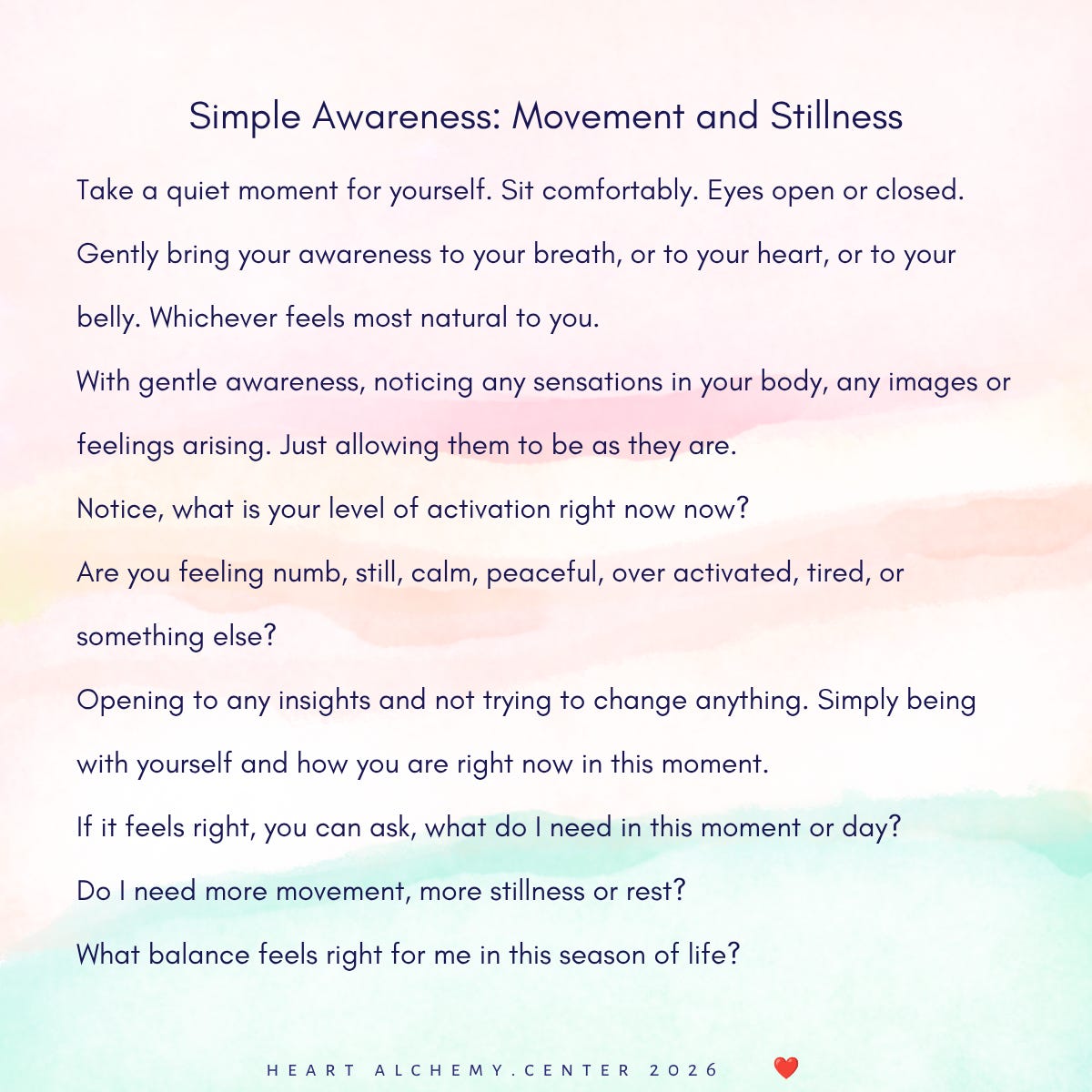
Movement, Rest, and Recovery: Finding Balance Through Awareness
The art of living is to be aware of one’s present state of being. – Mary Burmeister
Our awareness and ability to attune to our inner resources allows us to know for ourselves when and how much to move or rest. We know that too much of either creates imbalance or even ill health.
Research tells us that sitting or laying around too much is the new smoking; contributing to inflammatory processes and other health issues. But over exercise can also lead to serious health issues. We’ve all heard stories of marathoners who collapse at the end of the marathon in cardiac arrest. How can that be, most people say; weren’t they in great shape? Actually, they’ve exceeded their body’s capacity and worn out their system through too much activity. I’ve known clients and even other practitioners who developed serious conditions including chronic fatigue, organ collapse, or immune dysfunction after activities like cycling 20 miles a day. I’ve seen people whose systems were broken down after marathons and triathalons.
While some people thrive on intense activity, for some folks their commitment to movement exceeds their body’s capacity to recover. We need regular movement and workouts to keep healthy and vital. Recovery time and practices are the key.
What is your healthy capacity for exercise? For socializing, work, or play? Does it change with the seasons? It likely changes with your age and the season of life you are in. What do you notice and how can you adjust?
Rest, a form of stillness, is part of recovery time that allows the muscles (the heart is a muscle too) and systems of the body to recover after exertion. Over time this allows the body to adapt to the new demands being placed on it. When we over exert, ignoring our body’s signals, then things can break down.
Yet, in the balance, we know that we need to exert greater effort over time to attain our goals of physical health, strength, and stamina. Knowing your personal rhythms and physical capacity, and using your common sense allows you to find your balance. This requires continual awareness and making adjustments as needed to attain and keep the level of fitness and health you aspire to. You learn when to challenge yourself and when to back off and recoup.
Stress and Rest
Though a much more complex topic, beyond the scope of this article, we similarly need to take time out to rest, recover, and reset when dealing with stress, burnout, or trauma. Truly resting is a radical act in today’s culture which emphasizes and gives accolades for constantly striving and doing more and more.
It takes courage to say yes to rest and play in a culture where exhaustion is seen as a status symbol. ~ Brene Brown
Our American society pushes and encourages us to constantly strive, do, accomplish, and keep going. Work 80 hour weeks, make lots of money, produce, and keep going are some of the messages of our imbalanced society. Resting is indeed a radical act in this achievement-oriented culture which emphasizes external goals rather than listening and attuning to our internal needs and rhythms.
Seasonal Rhythms and Practices
Our bodies and psyches, being part of the natural world, follow the same rhythms as the seasons. The very cells of our body are attuned to the cycles of night and day, to the movements of the sun and moon. These are referred to as our circadian rhythms which influence our physiology and biological processes.
Practitioners of Chinese philosophy and medicine adjust their practices, movement, diet, and sleep habits seasonally in order to promote health. These practices have been handed down through many generations with a proven track record of at least a thousand years.
Our bodies and psyches also change throughout the seasons of our life, from childhood through our elder years. Women are especially aware of this as our bodies change dramatically from the first time we experience our monthly flow, through pregnancy if we have children, and then through the many surprises of peri-menopause, menopause, and post-menopause. In each phase, there’s often physical, mental, emotional, and life changes calling us to find a new balance and new patterns of movement and rest. As we move through these changes and phases, we can draw nourishment and strength from the deep well of our internal calm center.
I would love to live like a river flows, carried by the surprise of its own unfolding. ~ John O’Donohue
Stillness and Listening
The ability to be quiet with others is just as vital as the ability to converse. Stillness is needed to really listen. Pausing, allowing a space, before replying to a question. Listening with open heart and quiet mind is an ongoing process, skill, and even challenge at times. The ability to tune into ourselves and attune to our surroundings and those around us allows to know when and how much to move or rest; when to engage or withdraw. We are able to create boundaries around giving and receiving so we are not overwhelming others or depleting ourself.
Make your heart like a lake with a calm, still surface and great depths of kindness. ~ Lao Tzu
Appreciating Quietude
Make time each day for periods of quietude and simply appreciating the beauty and preciousness of life. Some of my favorite summer mornings are spending a little time outside in my garden. Maybe tending my garden, doing some gentle pruning or watering. Maybe sitting in my chair watching the clouds go by, noticing the spaciousness of the blue sky, the gaggle of geese flying in formation honking and flapping their wings, the turkey vulture soaring and surfing the wind currents, the dragonflies and hummingbirds flitting about the colorful flowers. Feeling the warmth of the tea mug cupped in my hands, my feet on the ground, and feeling the support of my chair as my dog Mocha drops her ball onto my lap and my other dog Ginger is wandering about munching weeds. Noticing the soft breeze and the fresh smell of summer air mingled with a hint of Jasmine flowers. The sky is spacious and the ground is abundant with beautiful flowers and colors.
Life is precious and there’s so much to be grateful for. Please take your time to enjoy your journey here.
from my heart to yours,
Suzanne
Note: I do not subscribe to AI so everything I write is my own and all errors are mine.